Unrepentant old school NJ Jewish mobster sings like a canary in Amazon documentary
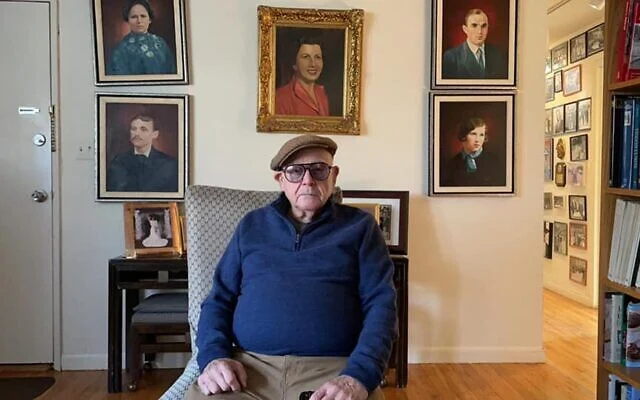
At almost 85, Myron Sugerman says he is the last “real” Jewish gangster: a one-of-a-kind outlaw, a self-made “king” of illegal slot machines, and a globetrotting adventurer whose clandestine missions included strategic and financial support for Nazi hunter Simon Wiesenthal.
Still with his trademark aviators, he’s now the subject of the new Amazon Prime documentary “Last Man Standing: The Chronicles of Myron Sugerman.” The film tracks the life of Sugerman, who was born in 1938 in Newark, New Jersey, and almost immediately catapulted into a life of crime by his father Barney Sugerman, otherwise known as “Sugie” — a prominent gangster in the Roaring Twenties.
Sugie was a member of the New Jersey Jewish Mob and associated with such other infamous characters as Meyer Lansky, Bugsy Seigel, Charles “Lucky” Luciano, Joe “Doc” Stacher, Abe Green and Abner “Longie” Zwillman, who was known as the Al Capone of New Jersey.
The younger Sugerman’s friends and associates were also all outlaws. “If somebody was ever to say to me, ‘Did you know anyone that was illegal?’ I never knew anybody that was legitimate,” Sugarman candidly says in the film. But, he adds, they were all solid guys who stood up to the violent antisemitism that was prevalent at the time.
Indeed, Sugerman’s first years coincided with the dramatic rise of the American Nazi movement, right on his doorstep. The German American Bund party was led by Fritz Kuhn, who proudly declared himself the “Hitler of the United States.” The group would meet in the local beer gardens and then, intoxicated, they would go into the old neighborhoods and beat up Jews.
Powerful archival footage of the infamous February 1939 Madison Square Garden Nazi rally in support of Nazism and fascism terrifyingly sets the scene of how European Jew-hatred was exported into the US.
The second-generation gangster recounts vividly how his father and other members of the Jewish mob responded to the surge in violence.
“There was always this question of Jewish pride,” Sugarman says in the film. “The Jewish gangster really had a psychological need to show that the Jews could be just as tough as any other ethnicity because they were going to break with the 2,000 years of our heads-down living in the ghetto, fearful. There was definitely no identity crisis. These Jews were tough and were ready to prove it.”
This led to the Jewish Mob’s creation of The Newark Minute Men, based upon the “minutemen” of the American Revolution, who were ready at a minute’s notice to take on the Brown Shirts of Fritz Kuhn in Newark and the surrounding areas.
Sugerman recollects how Luciano, one of the prime members of the Italian Mob, had a close relationship with Lansky and offered to help thwart the attacks against the Jews. Lansky’s response was: “Charlie, thank you, I am grateful, appreciate it, this is a Jewish problem and this is going to be resolved with Jewish fists.”
Growing up in this climate had a profound effect on Sugerman. Speaking to The Times of Israel via Zoom from his home in Montclair, New Jersey, Sugerman says that he’s always seen a chilling reminder of life’s destiny in the famous black and white photo of a young boy during the 1943 Warsaw Ghetto Uprising, his hands raised at gunpoint.
“By circumstances of birth that kid could have been born in America, and I could have been him,” Sugarman says.
This image, imprinted in Sugerman’s mind, became his raison d’etre to defend the Jewish people. The message was reinforced by his father who insisted that he and his brother take boxing lessons from a Jewish former professional, as was common at the time: “You are going to learn to defend yourself… you have that quiet weapon that nobody knows about.”